Malaysian educators who start looking at postgraduate study rarely begin with a brochure. They begin with a practical jam: a new subject head role, a district target that needs clearer teacher coaching, or a school that is changing faster than last year’s meeting minutes can absorb. An educational leadership masters is one way people try to name that work, then practise it with more structure. This piece is informational. It maps what such programmes typically cover and how that can sit beside day jobs and local pathways, not a pitch to enrol anywhere.
What leadership means inside Malaysian schools
In Malaysian schools, “leadership” is not only the pengetua or guru besar. Senior assistants, ketua panitia, and other middle leaders already carry instructional and people work between senior management and classroom teachers. Ministry pathways such as the National Professional Qualification for Educational Leaders (NPQEL) signal that selection and preparation for school heads are treated as national capacity work, not a casual title upgrade.
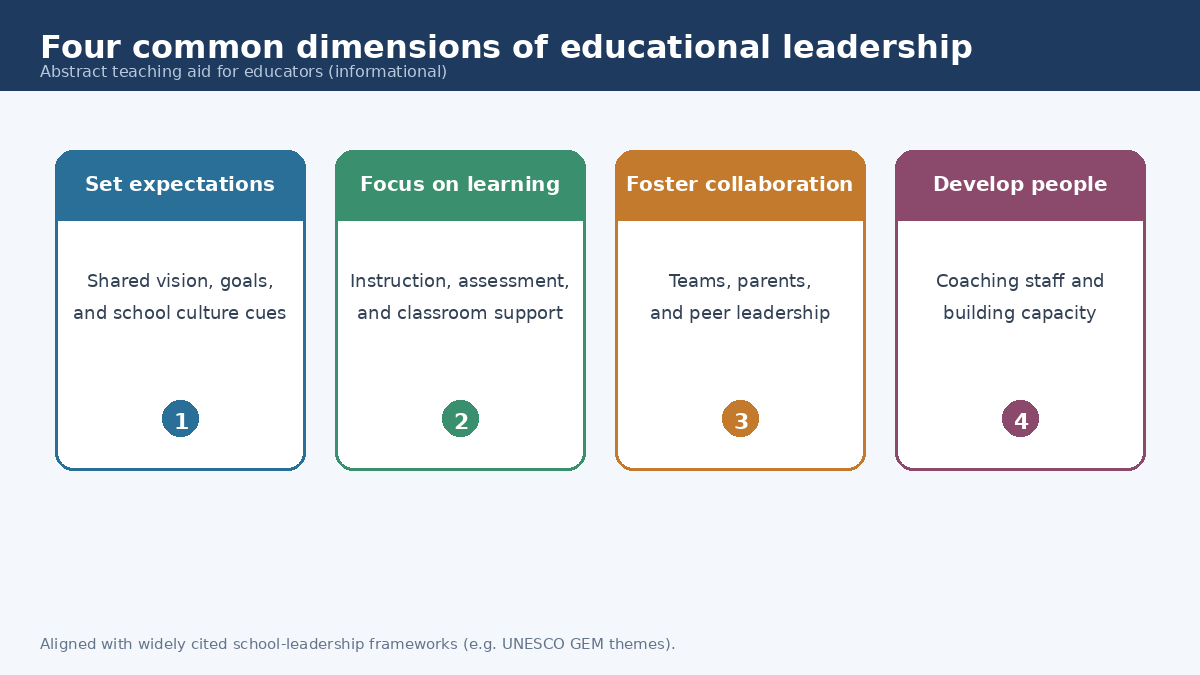
International evidence pushes in a similar direction. UNESCO’s Global Education Monitoring work on leadership in education stresses four recurring dimensions: set expectations, focus on learning, foster collaboration, and develop people. Those themes show up whether you are in a national school, an international campus, or a college unit that feels the same pressure to standardise and still care about learners.
What educational leadership masters programmes usually cover
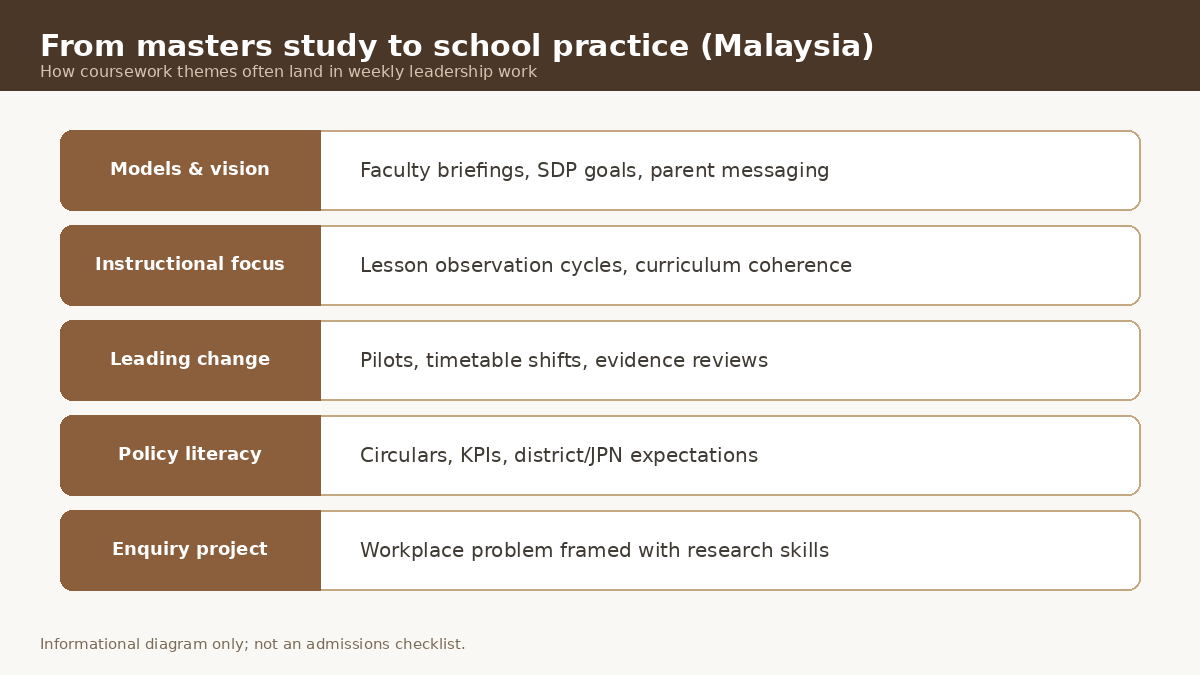
Syllabus labels differ by university, but the spine is surprisingly consistent. Most programmes move through models of educational leadership, how research is used (and misused) in schools, leading change without burning out teams, and how education policy shapes what leaders can actually decide. Practice-oriented courses also ask you to bring a workplace problem into the assignment rather than writing about leadership as a distant idea.
Public programme overviews of educational leadership masters topics often list units on leadership models, engagement with research, leading educational change, policy and leadership as social practice, plus a project or dissertation-style enquiry. That mix matters for Malaysian educators because the job is rarely “manage the timetable” alone. It is interpreting circulars, coaching colleagues, and deciding which change is worth the political cost inside one school.
UNESCO GEM Report launch session on leadership in education. Useful context on why systems invest in school leaders; not a programme advert.
Skills that show up at work the next week
Good coursework should leave residue you can use before graduation day. Observation and feedback conversations get sharper when you have language for instructional leadership rather than vague “please improve.” Change projects get less theatrical when you can separate productive motivators from counter-productive ones. Policy literacy helps when a KPI arrives from the district and you need to translate it into something teachers can actually do on Monday.
OECD work on preparing teachers and developing school leaders has long argued that autonomy without capable leadership is a weak bet: schools need people who can distribute leadership, support professional learning, and keep teaching quality in view. That is why masters study that stays glued to classroom and team practice tends to travel better than pure management theory. A short map of how themes land in weekly work sits below.
How a masters sits beside NPQEL and other postgraduate routes
For many educators in the public system, NPQEL and related Institut Aminuddin Baki pathways remain the formal gate toward pengetua or guru besar roles. A masters does not replace that architecture. It can complement it by deepening research habits, comparative perspectives, and reflective practice that national short courses may not have time to stretch. Private-sector educators and international-school middle leaders may use a masters more as career signalling and as a structured way to practise leading change across cultures.
Some mid-career professionals also compare education-focused study with broader executive postgraduate options. An executive MBA overview can sit as adjacent context when someone’s next role mixes education delivery with organisational finance, operations, or multi-site management. The decision is less about prestige labels and more about whether the weekly problems you face are mainly pedagogical and policy-shaped, or mainly enterprise-wide. Choose the tool that matches the jam you already have.
A quieter way to decide this quarter
Before you download another prospectus, write one page with three columns: the leadership problem that keeps returning at work; the skills you already have from experience; and the skills you still borrow from other people. Then ask which column a masters would actually move. If the gap is mainly certification for a posted role, start with the official MOE pathway notes. If the gap is critical reading of policy, coaching language, and a supervised enquiry into your own practice, that is closer to what educational leadership masters programmes are built to cover.
Keep the decision boring and specific. That usually beats a vague hope that “a masters will sort leadership” without naming which part of leadership was broken in the first place.